
Double-entry books
Real double-entry books your CA will accept
Underneath the simple daily flow is a proper double-entry engine: every invoice, payment and expense posts to the ledger, so your trial balance, profit & loss, balance sheet and cash flow are always current the moment you open them. This is the wedge that keeps your CA — you don't rip out Tally, you hand them a clean Tally-ready XML export and a permanent audit trail instead of a backup over AnyDesk.
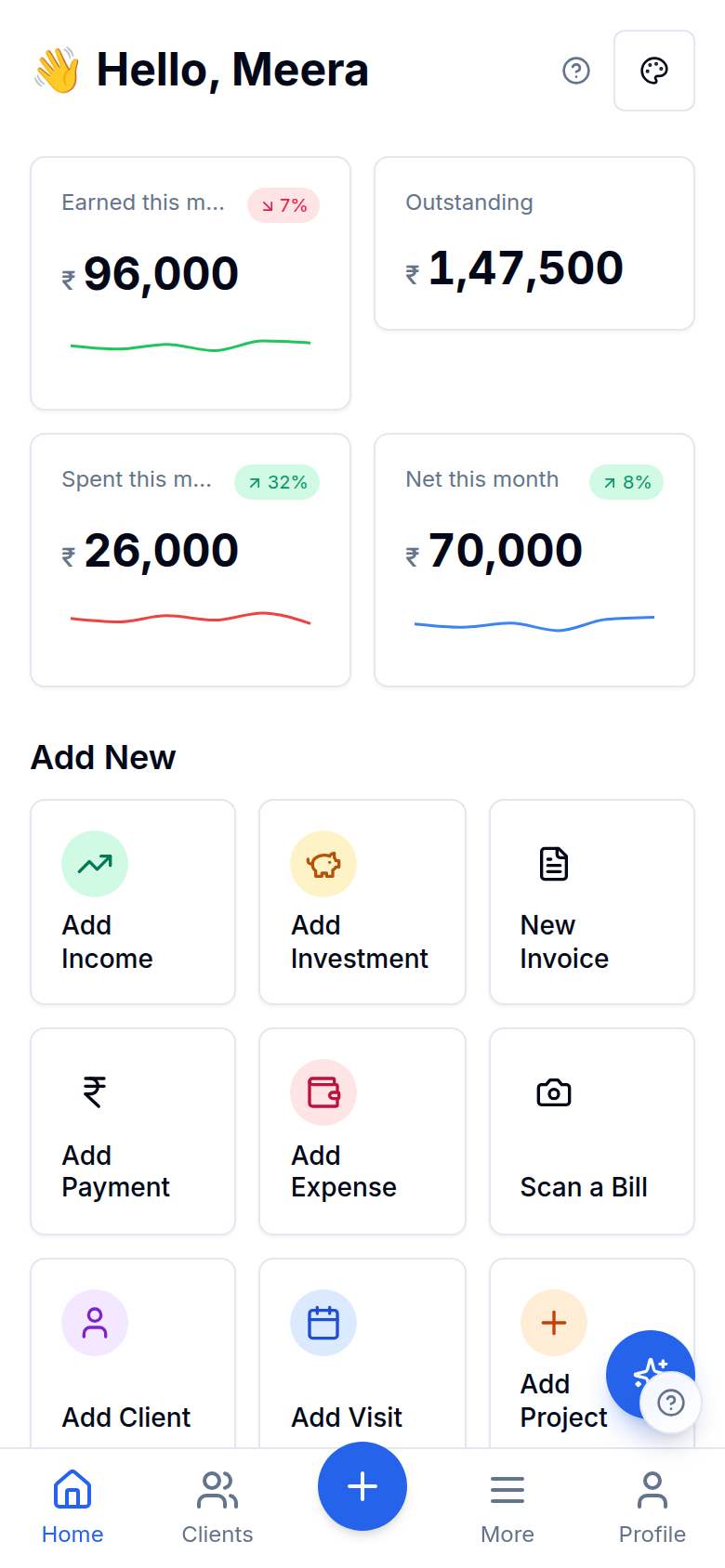
Actual app — a real screenshot on sample data, not a mock-up.
The four financial statements, live
Trial balance, profit & loss, balance sheet and cash flow — each recomputed from your own invoices, payments and expenses for any period you pick, so they're never stale.
Keep your CA — Tally-ready XML export
Export any date range as a single Tally-Prime XML: your ledgers and parties (masters) plus your invoices, payments and expenses (vouchers). Your accountant keeps working in Tally; you stop sharing backups over AnyDesk.
Day Book & Cashbook
A chronological voucher feed and a Tally-style Cash / UPI / Bank / Cheque account view, grouped and totalled by day — with a Voucher / Ledger / Narration vocabulary toggle for Tally users.
A permanent audit trail (Rule 11g)
Every edit or deletion of a money entry, journal voucher or ledger master is captured automatically — who changed it, when, and the full before-image. The log only grows, corrections are new entries, and it can never be switched off.
Outstanding, Statement of Account & payables
Receivables aged 0-30 / 31-60 / 61-90 / 90+ per client, a per-client running-balance statement, and a Payables tab that ages what you owe suppliers the same way — each a clean CA-format PDF.
Reports dashboard, budgets & ratios
Cashflow, income vs expense, top clients, payments by mode and expenses by category, plus budget-vs-actual and financial ratios (profitability, liquidity, leverage, efficiency) — with a dense 'CA view' toggle and any date range.
Hand-to-CA ZIP + read-only invite
Roll a whole range into one ZIP — every invoice PDF, statements, Day Book, Outstanding and GSTR-1/3B — or invite your accountant as a read-only member who lands on a portfolio dashboard and can never Add / Edit / Delete.
Deferred revenue & expense schedules
Spread an invoice or a prepaid bill across the months it really belongs to — each period's recognition posts as a balanced voucher, the total is recognised exactly once, and the deferral account on your balance sheet winds back to zero when it's done.
Period-end FX revaluation
Revalue your open foreign-currency receivables and payables at the closing rate at period end; Finocket posts a balanced, reversible unrealized gain or loss journal so your trial balance still foots to zero. Realized-on-settlement gains and foreign-currency bank balances are the next step.
Recurring journal vouchers
Set a balanced Dr/Cr journal — a provision, an amortisation, a standing accrual — to auto-post on a cadence, idempotent per period so it books once and always balances.
Per-line splits across several dimensions at once
Split a single invoice LINE — or a single journal line — across a branch AND a project AND a fund at the same time, each axis footing independently to exactly 100% with the amounts foot to the paise, and read a profit & loss per dimension that still ties back to the whole. It's a reporting distribution: the splits change how the number is sliced, never what posts to the ledger.
Working capital that states its own method
DSO, DPO and the gap between them, plus receivable and payable concentration — with the convention named on the screen, in the emailed report and in the API tool description: closing balances over an exact inclusive day span, no 360-day year and no averaged balances (we don't snapshot historic receivables, so an average would have to be invented). A period that can't produce a meaningful denominator reads an honest 'NA' with the reason, never a made-up number.
Exceptions found by arithmetic, not by AI
Duplicate payments, duplicate expenses, spend outliers and revenue drops or spikes, detected with zero AI calls: median-and-MAD baselines so one historic spike can't poison a threshold, and three independent gates (ratio, absolute rupee delta and robust-z) before anything is raised. Dismiss one and it stays dismissed; next period re-checks. Spend-by-category reads your expense records rather than the general ledger, and revenue is judged on the last complete month.
A proactive insight digest, emailed
Schedule a digest that arrives before you think to ask for it — cash outlook, receivables, payables, GST deadlines and exceptions, each re-shaped from the engines above rather than re-detected. It rides the same report-schedule delivery as your other emails, the emailed copy matches the screen, and if a source can't be read it says so instead of showing ₹0. The optional written summary needs the AI assistant and a Pro tier; without it you get the numbers.
Scheduled report emails
Have your receivables ageing, payables ageing or financial ratios emailed as a PDF or CSV on a daily, weekly or monthly schedule — sent once per period, and honest about it when no sending email is connected yet.
Build your own reports, pin them live
An un-gated report builder lets you filter, group, total and sort across invoices, expenses, payments, clients and items — your custom fields included — then save it and pin it to a dashboard as a live number, table or chart that refreshes every time you open it.
A vendor portal for your suppliers
Send a supplier one private link — no login — where they see their purchase orders, the bills you've recorded against them and their payment history, and can upload their invoice for you to review. An upload never auto-posts a bill; a person always records it, and one link only ever resolves to one vendor.
Cash-flow forecast
See where your closing cash is heading over the coming weeks or months, built from what customers owe you and the bills you owe at their due dates — with best / base / worst cases to stress-test it. Do the money-in-the-morning task before the money runs out.
3-way match & goods receipt
Line up, purchase order by purchase order, what you ordered against what actually arrived and what you were billed — short deliveries, over-billing and price differences flagged — and record a goods receipt (GRN) on the spot before you pay a supplier.
Chart of accounts, ledgers & manual journals
A full chart of accounts with groups, a per-account ledger view, and manual journal vouchers for the entries only a human should make — the Tally depth your CA expects, on your phone.
Dimensional P&L
Slice your profit & loss by project, department or fund — deeper than a single cost-centre split — so you can read profitability the way you actually run the business.
Reports that explain themselves
Profit & loss, outstanding, GST returns, the forecast and the books cash-flow each carry deterministic fact chips computed from your own numbers, with an optional written summary on top. The chips are always there; the summary is optional and can be empty — module off, quota used up, provider down, or the grounding guard stripping every sentence all render the same chips. The forecast card is deliberately kept out of strict Tally-style statements, because a projection doesn't belong in a statutory one.
Explore more
Ready to ditch the spreadsheet?
Free for solo users until 31 Dec 2026 — no partner code needed. ₹99/month after that. No credit card. Your books stay yours.