
Compare
Everything Finocket does, next to everything else
41 switchable modules across six areas — books and GST, the customer, outreach, partners, the platform edges and the owner's own money — laid out beside the tools you might use instead. We name what each of them is genuinely great at, and who should pick them.
Each one is a real screen with its own data, not a checkbox on a plan.
Self-serve from Settings — on for your whole team the moment you flip it.
Sub-modules share a parent's surface, so the app stays as small as your choices.
What the modules look like when they're switched on
Real screens from the app — the same records, whichever module you came for.
One workspace, not a stack
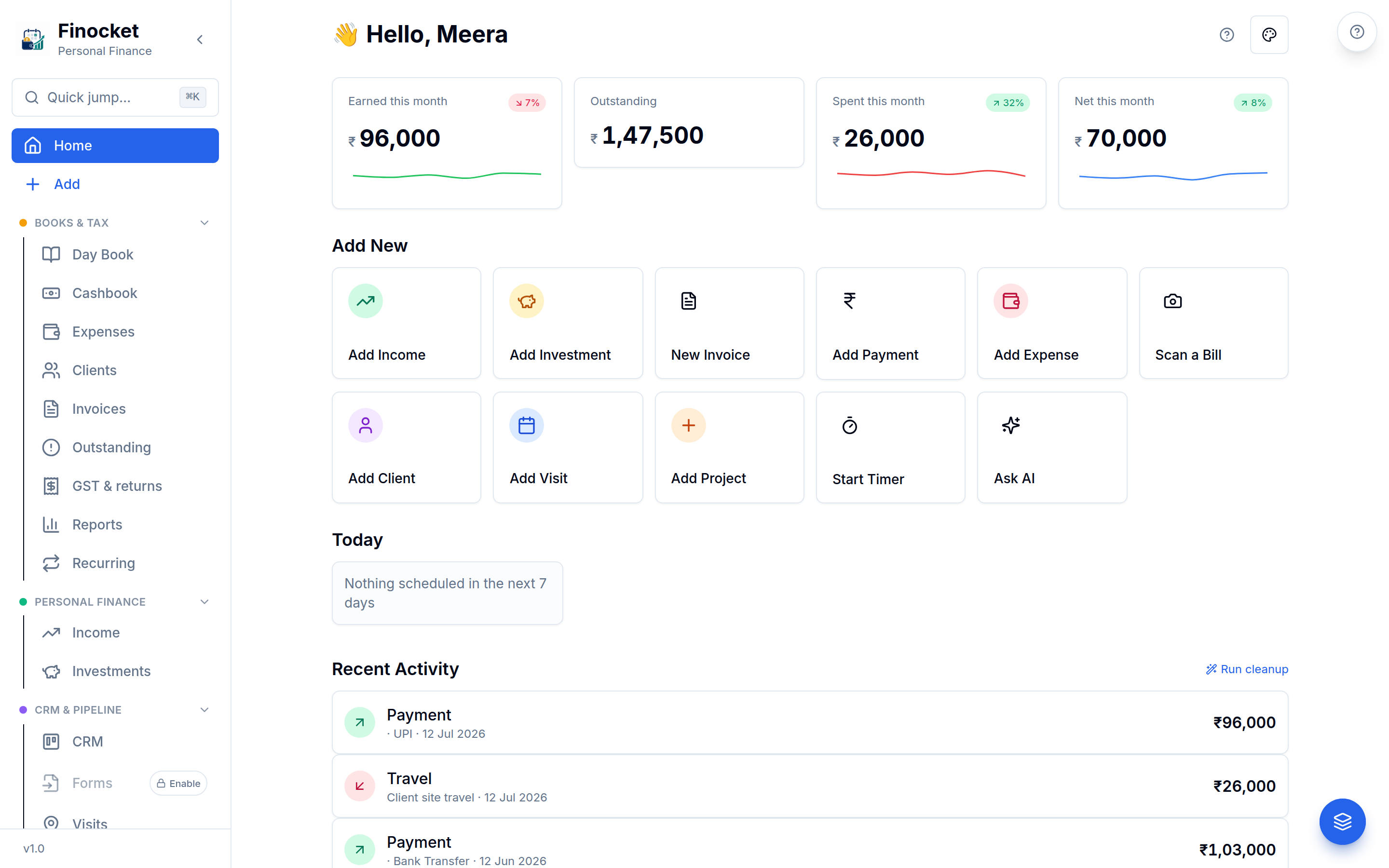
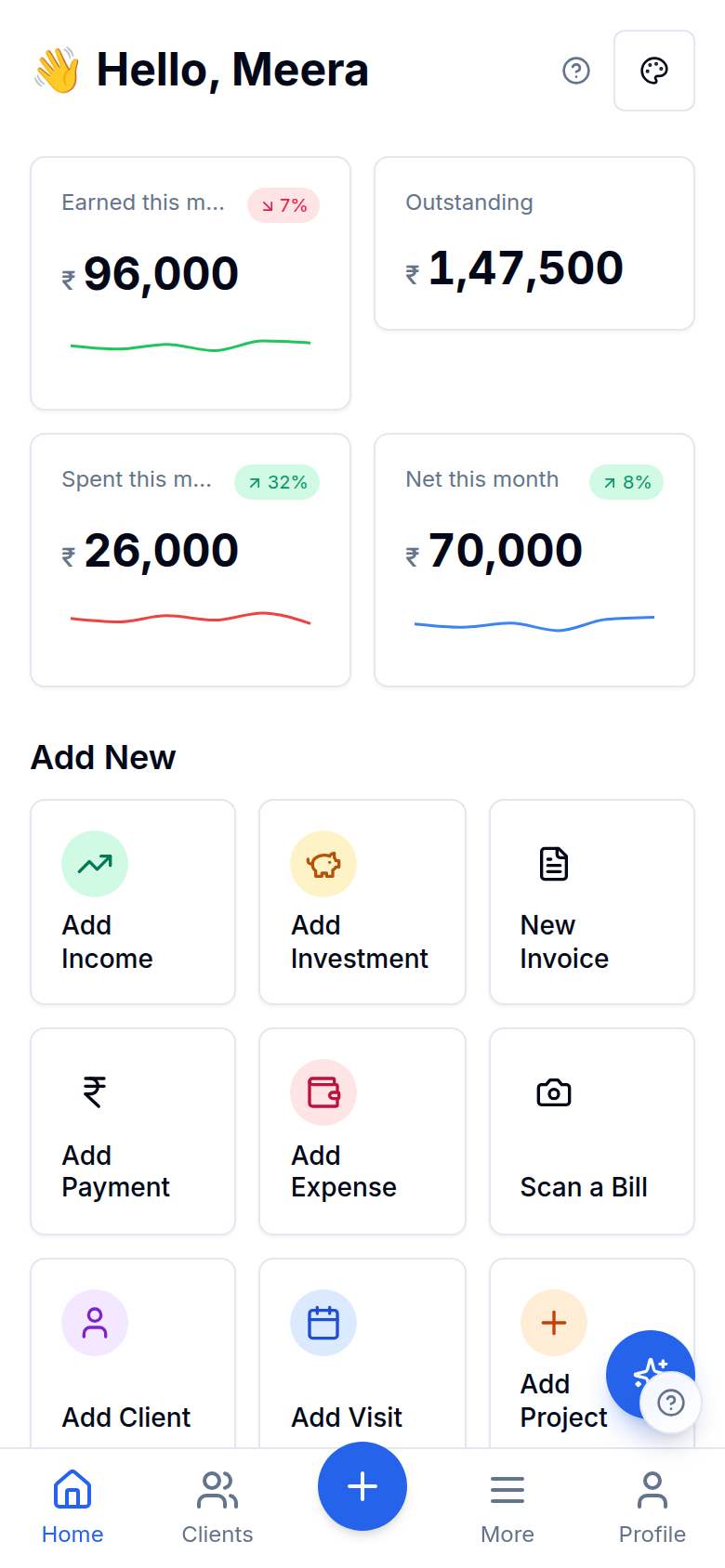
The invoice an incumbent charges a licence for
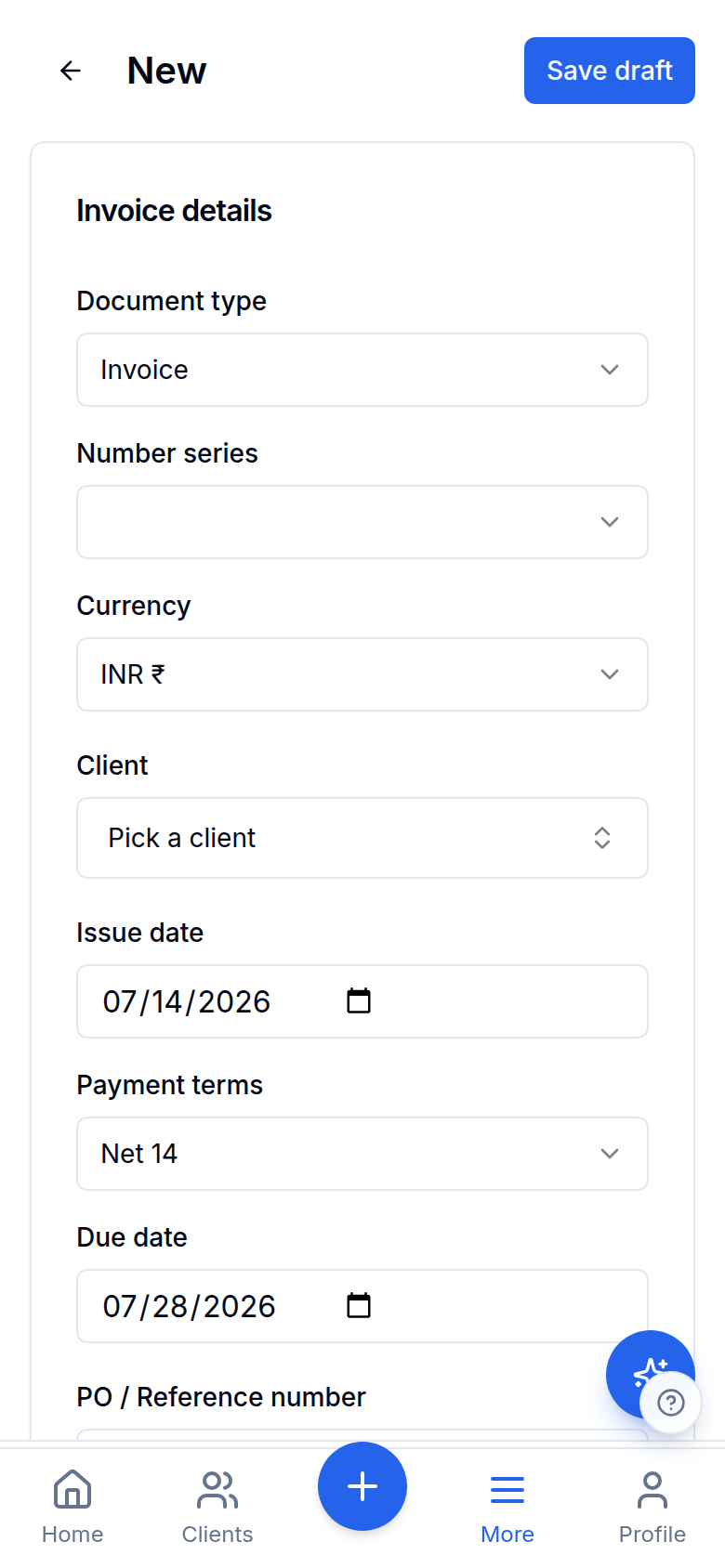
The return builds itself from what you already recorded
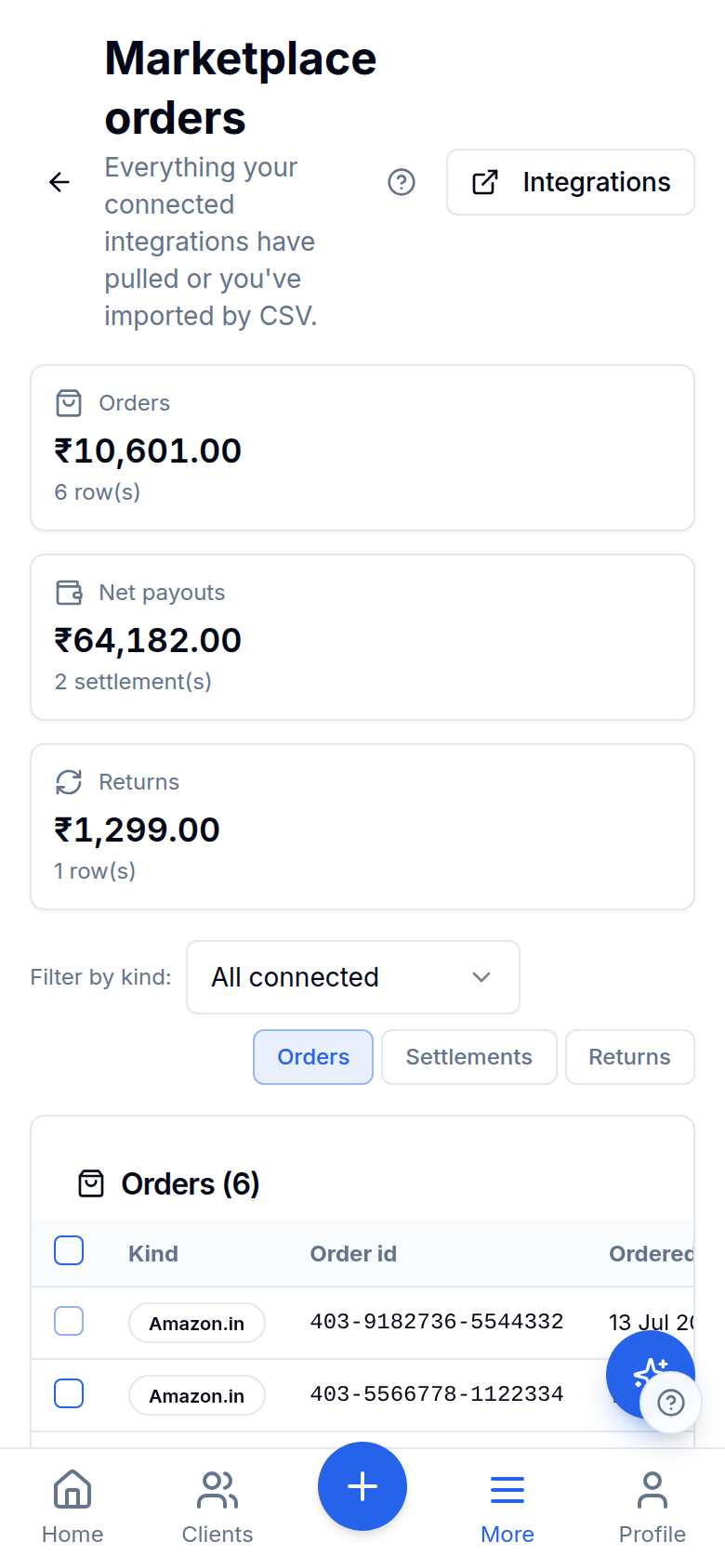
And the money that arrives from somebody else's platform
Every area, and how the alternatives cover it
Straight from the product registry — the same list your Settings switchboard shows, in the same words.
Books, GST and the money that moves
15 modulesDouble-entry books a CA will sign off, and everything a working Indian business bolts on around them — GST and TDS returns, bank reconciliation, stock, sales and purchase orders, the shop counter, cost centres, production runs and depreciation.
Hotel & stays
Rooms and beds, availability and reservations for a hotel, lodge, homestay or PG, in the same books as your invoices.
Where else you'd get this
Tally is the benchmark here, and it is the one incumbent that does not charge you again for scale: extra companies and extra GSTINs cost nothing, on top of ₹8,100 a year to rent Silver or ₹22,500 to own it outright. Zoho Books runs ₹749–7,999 a month billed annually and asks ₹600 per location per month for each further GSTIN. Both are one lane — the ledger. Everything below is that lane and the ones either side of it, switched on one at a time.
Read Finocket vs TallyThe customer, before and after the invoice
12 modulesThe pipeline that brings the work in, the work itself, and the record you keep of the customer afterwards — lead to deal to invoice to payment, without leaving the ledger it all lands in.
Where else you'd get this
Vyapar's Silver licence is ₹4,399 a year and covers three firms; myBillBook is ₹3,490 a year for Plus and ₹3,990 for Pro, with multi-company reserved for Pro Max. Both are billing apps — the pipeline, the follow-up and the history of the customer live in something else, usually priced per seat, so the people who only need to look pay the same as the people who sell.
Read Finocket vs Zoho CRMReaching people, with the consent on file
4 modulesCampaigns, follow-up sequences, dynamic QR codes that never deactivate, and one canonical UTM set across all of it — with every send resolved against a per-contact consent ledger before it leaves.
Where else you'd get this
Marketing tools sell reach and carry consent as a checkbox on a form. Here it is a ledger: the timestamp, the IP and the exact opt-in text the person agreed to, checked at the one place a send can happen. That is a different claim from a bigger send quota, and it is the one a DPDP-era buyer is actually asking about.
Read Finocket vs HubSpotPartners, commission and the statement your CA pays from
3 modulesReferral attribution and a self-serve partner portal, an append-only commission ledger that accrues on revenue you actually collected, and a monthly per-partner statement with the tax treatment worked out.
Where else you'd get this
PartnerStack, Rewardful, Tolt and FirstPromoter are separate trackers wired onto your billing, and they earn their fee by moving the money and filing the forms. Finocket deliberately does not move money — it computes what is owed in the same ledger as your books and hands your accountant a statement to execute.
Read Finocket vs affiliate trackersThe edges — your systems, their systems, and the rules between
5 modulesMarketplace settlements imported as finance, a versioned REST API with signed webhooks, approval steps and workflow rules on the records that matter, and a reviewed two-way sync with a TallyPrime company.
Marketplaces & integrations
Amazon, Flipkart, Meesho and quick-commerce ingestion, plus a live integration catalog of every connectable surface.
Tally sync
BetaBring vouchers across from a TallyPrime company and review every one of them before it reaches your books — with a plan you read first, a mapping queue that never guesses a ledger, and a bulk rollback that says exactly what it removed, what it reversed and what it had to keep.
Where else you'd get this
This is where the desktop incumbents charge again: Marg is ₹5,550–26,000 one-time plus ₹3,000 for each additional company, and BUSY includes multi-company on its free tier but puts multi-GSTIN on the ₹22,000 Enterprise edition. On Finocket the edges are modules like any other — switch on the API, the approvals or the Tally sync the day you need one.
Read Finocket vs BUSYThe owner's own money
2 modulesSalary, interest, rent and dividends logged as personal income, and ELSS, NPS, PF/PPF, FD, gold, mutual funds and stocks tracked against your 80C headroom — kept apart from the business books, in the same app.
Where else you'd get this
None of the books apps on this page is built for this. They stop at the company's ledger, which is right for a private limited and wrong for the proprietor whose business and personal money genuinely are one — and whose 80C planning therefore ends up in a spreadsheet. Finocket hides these two from an incorporated entity for exactly the same reason.
Read Finocket vs KhatabookWhat the alternatives charge — and where they charge again
Read from each vendor's own pricing page as of September 2026. Finocket's ladder lives on one page, so it is not restated here.
| Tool | What you buy | List price | A second company or GSTIN |
|---|---|---|---|
| Tally | Silver, single user | ₹8,100/yr rental, or ₹22,500 outright | Extra companies and extra GSTINs: free |
| Zoho Books | Standard → Ultimate, billed annually | ₹749–7,999/mo | Each further GSTIN: ₹600 per location per month |
| Vyapar | Silver | ₹4,399/yr | Covers 3 firms |
| myBillBook | Plus / Pro | ₹3,490 / ₹3,990 per year | Multi-company only from Pro Max |
| BUSY | Free edition | ₹0 | Multi-company included; multi-GSTIN needs Enterprise at ₹22,000 |
| Marg | Desktop licence | ₹5,550–26,000 one-time | ₹3,000 per additional company |
Prices move. Every figure here carries the month it was read, so you can tell how old it is instead of trusting it — and Tally, honestly, is the one that does not charge you again for a second company or a second registration. See what Finocket costs.
Feature parity, measured
We match the incumbents — then add the connected record
features matched — plus mobile, AI and a Tally XML your CA still files from.
features matched — deeper on India, and no five-to-twenty-five-lakh implementation.
features matched — with no invoice caps, and Solo free until 31 Dec 2026.
Every comparison below names what the other tool is genuinely great at — and who should pick them. Honesty is the differentiator.
Accounting & books
CRM & sales
No middleman
The app, not a six-month implementation
Big ERPs make you hire an implementation partner and pay lakhs before you invoice a single client. Finocket is different — you sign up and start today, and our team looks after the rest, for every kind of business.
No implementation partner
No VAR, no consultant, no TDL programmer. Setup help comes from our own team — and it's included, not a paid rollout you budget lakhs for.
One team, every use case
Jeweller, distributor, clinic, agency or CA — we build the depth into the product itself, so you never hire an integrator to bolt your workflow on.
Talk to the people who build it
Feedback and new-feature requests go straight to the team that makes Finocket — and India-first is our default, not a plugin you pay extra for.
Pick the modules you need. Ignore the rest.
Free for solo users until 31 Dec 2026 — no partner code needed. ₹99/month after that. No credit card, and nothing switched on that you didn't ask for.