
GST & returns
Tax that files itself into your GSTR-1 and 3B
GSTIN per client, CGST/SGST/IGST splits, credit notes, GSTR-1 and GSTR-3B, input tax credit, reverse charge and TDS, correct before you file.
What it solves
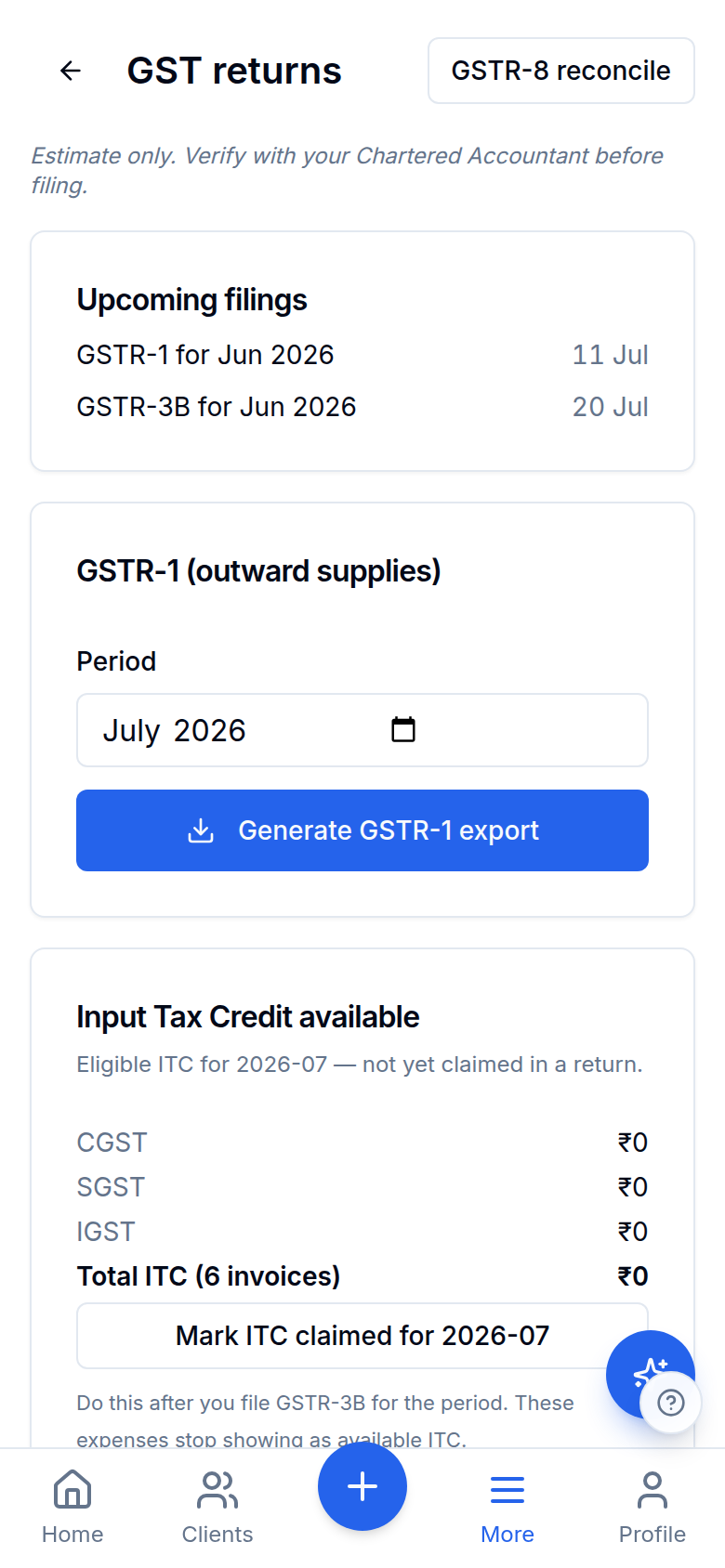
Filing month is a scramble because the tax detail lives in the invoices but the return lives in a spreadsheet. Finocket puts the two together: every invoice, expense and payment already carries the tax detail your return needs, so when it's time to file the numbers are already there: GSTR-1 as the ZIP the GSTN offline tool accepts, GSTR-3B computed section by section.
How we're different
The place of supply is derived from each client's validated GSTIN, so intra-state vs inter-state (CGST+SGST vs IGST) is decided for you. Credit notes are a first-class document with their own series that correctly reduce your returns and outstanding, and TDS your client withheld is captured on the payment while the invoice still marks fully paid at gross.

Inside GST & returns
GSTIN per client, validated live
CGST / SGST / IGST on every line
Credit notes done right
GST & returns
Credit notes done right
GSTR-1 & GSTR-3B, ready to file
GST & returns
GSTR-1 & GSTR-3B, ready to file
Expense ITC + reverse charge
GST & returns
Expense ITC + reverse charge
GST & returns
Credit notes done right
GST & returns
GSTR-1 & GSTR-3B, ready to file
GST & returns
Expense ITC + reverse charge
More in GST & returns
TDS on customer payments
Record tax your client withheld under 194J, 194C, 194H and others. The invoice still marks fully paid at gross, and a year-end summary reconciles against Form 26AS.
Import ITC via bill of entry
Record a customs bill of entry (number, date, port, assessable value, IGST and cess), flag the ITC eligible, and the period's eligible import IGST lands on the GSTR-3B 4(A)(1) 'Import of goods' line and folds into your net IGST, never double-counted with inward or reverse-charge credit.
ISD distribution register
Distribute common input-service GST credit across your GSTINs pro-rata (by turnover ratio or manually), with each of IGST/CGST/SGST footing back to the head total to the paise, and a balanced journal that reclasses the distributed ITC out of your GST-Input pool. It's a single-company aggregate reclass: the per-branch detail lives in the register, not posted into each recipient GSTIN's own books.
DRC-01B / DRC-01C self-check
Run the department's own Rule 88C and Rule 88D checks on your own figures before a notice does: GSTR-1 output tax against GSTR-3B 3.1, and GSTR-2B ITC available against GSTR-3B table 4. A tied month reads all-clear; a real gap shows the exact per-head difference. A self-check on your numbers, not a portal filing.
Consolidated GSTR-1 & 3B across GSTINs
Run one read-only GSTR-1 and GSTR-3B summary across every GSTIN you keep (each GSTIN its own column, every consolidated cell the exact sum of its per-GSTIN cells), so a multi-branch group reads the whole picture before each entity files its own return.
GSTR-2B from portal JSON or from a PDF
Import the portal's 2B JSON as an exact parse with no model involved. No JSON to hand? Upload the PDF and Finocket reads it, validating each GSTIN's checksum and cross-checking the printed totals. Every machine-read line is flagged 'needs review' until you verify it against the portal, because a scanned 2B is not authoritative ITC data and shouldn't be claimed as if it were.
A notice register, and a reply built from your ledger
Record a GST notice exactly as you received it. Every field is entered by you, never inferred, because a notice fact the app invented would end up quoted back at a tax officer. Then assemble a reply whose every figure resolves from a frozen pack of your own rows: the reply document structurally cannot hold a number that isn't cited. It can't claim to be complete while a rupee is unexplained (the database enforces that), and approving freezes the evidence, the document and a hash of both, so different copy can't be swapped in behind the approval. Finocket files nothing and sends nothing: there is no submission state anywhere in it. It also won't guess your reply deadline. The statutory windows aren't verified, so it shows none rather than a wrong one.
Questions
Can I file GSTR-1 and GSTR-3B from Finocket?
Finocket builds them from your invoices and expenses: GSTR-1 downloads as a ZIP of section CSVs (b2b, b2cl, b2cs, cdnr, exp, hsn, docs) that the GSTN offline tool accepts, and GSTR-3B computes Section 3.1 and Section 4 for you to file.
How are credit notes handled?
As a first-class document with its own numbering series. A credit note correctly reduces your GSTR-1, GSTR-3B and the client's outstanding, filed under the proper CDNR / CDNUR sections.
Can I record TDS my client deducted?
Yes. Record the TDS withheld on the payment (194J, 194C, 194H, 194I and more). The invoice still shows fully paid at the gross figure, and a year-end summary reconciles against Form 26AS.
Does Finocket handle import ITC, ISD and mismatch checks?
Yes. Record a customs bill of entry and its eligible IGST lands on the GSTR-3B 4(A)(1) import line; distribute common input-service credit across your GSTINs with an ISD register and a balanced reclass journal (a single-company aggregate move, the per-branch detail kept in the register); and run the department's own DRC-01B/DRC-01C checks on your own figures before a notice arrives (a self-check, not a portal filing). Finocket generates portal-ready files; you or your CA upload them.
What if I actually receive a GST notice?
Record it in the notice register exactly as it arrived (every field entered by you, never inferred), then build a reply whose every figure resolves from a frozen pack of your own rows. The document structurally cannot hold an uncited number, and it cannot claim completeness while a rupee is unexplained. Approving freezes the evidence, the document and a hash of both, so the copy behind an approval can't be swapped. Finocket does not file or send it, and it will not guess your reply deadline. The statutory windows ship unverified, so it shows none rather than a wrong one.
Can I import GSTR-2B if I only have the PDF?
Yes. Finocket reads the PDF, validates each GSTIN's checksum and cross-checks the printed totals. Every machine-read line is flagged 'needs review' until you verify it against the portal: a scanned 2B is not treated as authoritative ITC data. Portal JSON, by contrast, is a pure parse with no model involved.
You file on time without a spreadsheet, and you see an ITC mismatch before the department does.
Where this wins
Learn how it works
Reports, GSTR-1 / 3B and Hand-to-CA
Cashflow, income vs expenses, projects, GST returns (GSTR-1, 3B, 8, ITC summary), TDS summary and the one-tap Hand-to-CA ZIP bundle.
Your accountant prepares, you approve
An accountant can prepare a GST return and send it for your approval. They cannot approve it themselves, you see the tax payable before you agree, and if the figures change afterwards the approval stops counting.
3 min read
Filling a client in from their GSTIN
Type a GSTIN and Finocket fetches the name and address from the GST portal, for your clients and for your own business during setup. PAN and state fill instantly from the number itself, and it warns you about a cancelled or composition registration.
3 min read
Ready to ditch the spreadsheet?
Free for solo users until 31 Dec 2026 — no partner code needed. ₹99/month after that. No credit card. Your books stay yours.