
Reports & books
Real double-entry books your CA will accept
Trial balance, P&L, balance sheet and cash flow from a proper double-entry ledger, plus Day Book, Cashbook, a permanent audit trail and one-tap Tally XML your CA imports.
What it solves
Most simple billing apps give you a list of invoices rather than books, so at year-end your CA still rebuilds everything in Tally. Finocket keeps a proper double-entry ledger underneath the daily flow: every invoice, payment and expense posts to it, so your four financial statements are current the moment you open them, and your accountant gets a clean export instead of a backup over AnyDesk.
How we're different
Finocket keeps your CA rather than replacing them. You don't rip out Tally; you hand over a Tally-ready XML of masters and vouchers for any date range. A permanent Rule 11g audit trail records every edit and deletion with its before-image and can never be switched off, and a read-only CA invite lands your accountant on a portfolio dashboard they can't Add / Edit / Delete from.

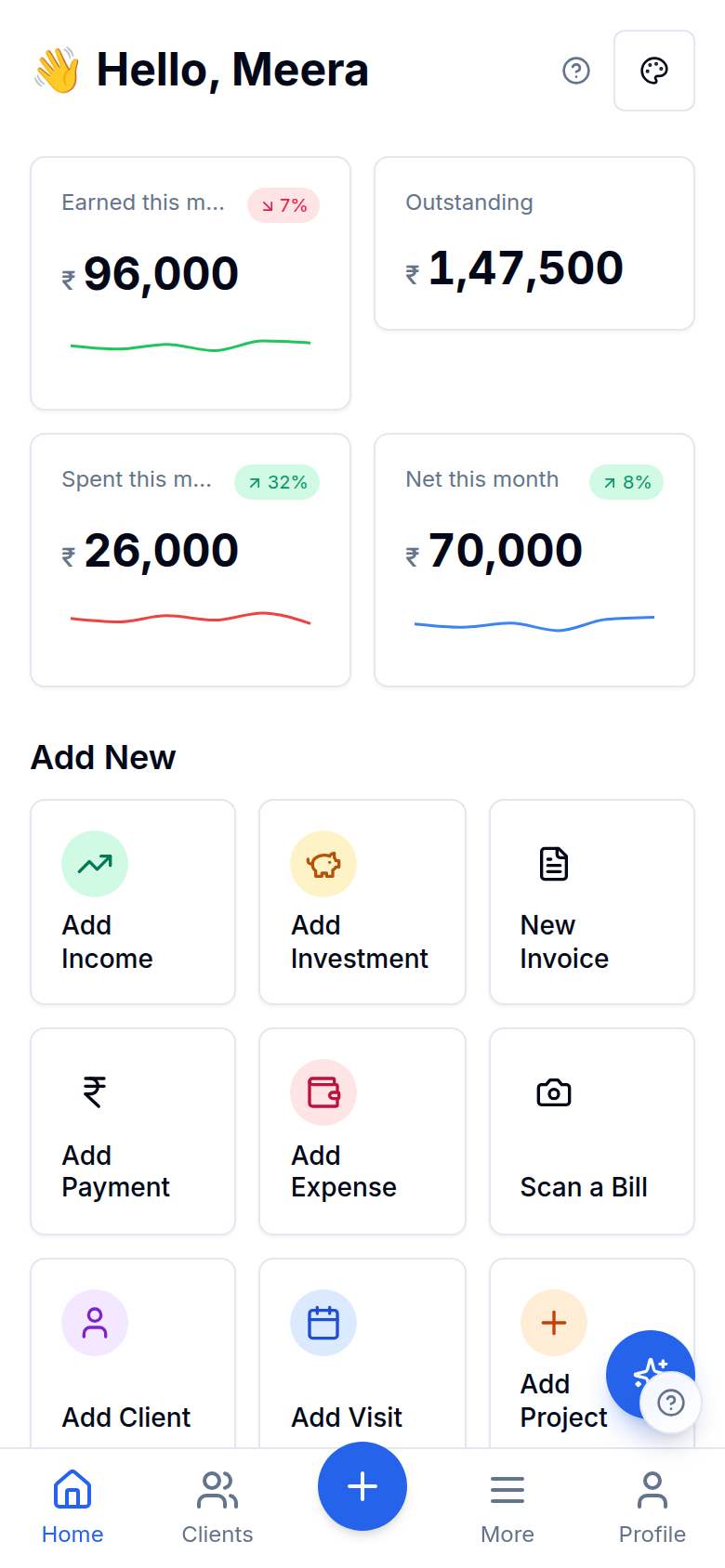
Inside Reports & books
The four financial statements, live
Tally-ready XML export for your CA
Day Book & Cashbook
Reports & books
Day Book & Cashbook
A permanent audit trail (Rule 11g)
Reports & books
A permanent audit trail (Rule 11g)
Outstanding, statements & payables
Reports & books
Outstanding, statements & payables
Reports & books
Day Book & Cashbook
Reports & books
A permanent audit trail (Rule 11g)
Reports & books
Outstanding, statements & payables
More in Reports & books
Reports, budgets & ratios, Hand-to-CA
Cashflow, income vs expense, top clients, budget-vs-actual and financial ratios with a dense 'CA view' toggle, or roll a whole range into one Hand-to-CA ZIP.
Deferred revenue & expense
Spread a prepaid invoice or bill across the months it belongs to; each period's recognition posts as a balanced voucher, the total recognises exactly once, and the deferral account winds back to zero.
Period-end FX revaluation
Revalue open foreign-currency receivables and payables at the closing rate and post a balanced, reversible unrealized gain/loss journal, so the trial balance still foots to zero at period end. Realized-on-settlement gains are the next step.
Scheduled report emails & a report builder
Have receivables ageing, payables or ratios emailed as PDF/CSV on a daily, weekly or monthly schedule; or build your own report over invoices, expenses, payments, clients and items (custom fields included) and pin it to a dashboard as a live number, table or chart.
Working capital that states its own method
DSO, DPO and the gap between them, plus receivable and payable concentration, with the convention named on the screen, in the emailed copy and in the API tool: closing balances over an exact inclusive day span, no 360-day year and no averaged balances, because Finocket doesn't snapshot historic receivables and an average would have to be invented. Cash sales are deliberately not blended into revenue, and a period with no meaningful denominator reads an honest 'NA' with the reason.
Exceptions found by arithmetic, not AI
Duplicate payments, duplicate expenses, spend outliers and revenue drops or spikes, with zero AI calls: median-and-MAD baselines so one historic spike can't poison a threshold, and three independent gates (ratio, absolute rupee delta and robust-z) before anything is raised. Dismissals stick and the next period re-checks. Spend-by-category reads your expense records rather than the ledger (every expense posts to one generic account), and revenue is judged on the last complete month.
A digest that arrives before you ask
Schedule an insight digest covering cash outlook, receivables, payables, GST deadlines and exceptions, each section re-shaped from the engines above rather than re-detected. It adds no delivery of its own: it rides the same report-schedule email path, the emailed copy matches the screen, and an unreadable source says so instead of showing ₹0. The optional written summary needs the AI assistant and a Pro tier; without it you get the numbers.
Works with the rest of Finocket
Part of Double-entry books. See how every module connects.
Questions
Are these real double-entry books?
Yes. Every invoice, payment and expense posts to a proper double-entry ledger, so your trial balance, profit & loss, balance sheet and cash flow are always current for any period you pick.
Can my CA keep using Tally?
Yes. Export any date range as a single Tally-Prime XML of your ledgers, parties and vouchers and hand it over, or invite your accountant as a read-only member who lands on a portfolio dashboard and can never Add / Edit / Delete.
Is there an audit trail?
A permanent Rule 11g audit trail captures every edit and deletion with who did it, when, and the full before-image. It only grows, corrections are new entries, and it can't be turned off.
Can I defer income over months and revalue foreign balances?
Yes. Defer a prepaid invoice or bill across N months with balanced per-period recognition, and revalue open foreign-currency receivables and payables at period end with a reversible unrealized gain/loss journal that keeps your trial balance at zero. You can also schedule ageing and ratio reports by email and build your own report over your data.
Will it flag a duplicate payment or a spend spike?
Yes, and without an AI bill, because the detection is arithmetic. Duplicate payments and expenses, spend outliers and revenue drops or spikes are found using median-and-MAD baselines (so one historic spike can't move the threshold) with three independent gates before anything is raised. A dismissal sticks, and the next period is re-checked. Spend-by-category reads your expense records rather than the general ledger, and revenue is judged on the last complete month.
Can I get a DSO number I can defend to a CA?
Yes. The working-capital report names its own convention on the screen, in the emailed copy and in the API tool description: closing balances over an exact inclusive day span, with no 360-day year and no averaged balances (Finocket doesn't snapshot historic receivables, so an average would have to be invented). If a period can't produce a meaningful denominator it reads 'NA' with the reason instead of a made-up figure.
You know where the money is every morning, without waiting for the month-end close.
Learn how it works
Ledgers, journal vouchers and your chart of accounts
The double-entry layer under your invoices and expenses: the chart of accounts, a running ledger per account, and manual journal vouchers that will not post unless they balance.
Financial statements: trial balance, P&L, balance sheet & cash flow
The four core statements built straight from your books (trial balance, profit & loss, balance sheet and cash flow), recomputed from every invoice, payment and expense, with a period picker and a clean CA handoff.
Coming from Tally?
Every Tally term mapped to its Finocket equivalent: Voucher / Ledger / Party / Narration / Day Book / F-key shortcuts and more.
Ready to ditch the spreadsheet?
Free for solo users until 31 Dec 2026 — no partner code needed. ₹99/month after that. No credit card. Your books stay yours.